Personalized Medical Care & Dedicated International Patient Concierge


Dermatology & Skin Care · Needs Clinic Confirmation
Laser Tattoo Removal
Laser tattoo removal is a specialized procedure that uses precisely calibrated laser energy to break down tattoo pigment particles beneath the skin — allowing the body's natural metabolic processes to eliminate them progressively over a series of treatment…
Schedule a ConsultationLaser Tattoo Removal

What Is Laser Tattoo Removal? Overview at Deesse
Laser tattoo removal is a specialized procedure that uses precisely calibrated laser energy to break down tattoo pigment particles beneath the skin — allowing the body's natural metabolic processes to eliminate them progressively over a series of treatment sessions. At Deesse Plastic Surgery, the Reverse system is applied — combining detailed pigment analysis, individually calibrated laser settings, and optimized treatment protocols to achieve effective clearance while minimizing unnecessary damage to surrounding tissue.
The core principle behind laser tattoo removal at Deesse is that effective treatment is not simply a matter of applying strong laser energy to the skin. Every tattoo presents differently — the colors used, the depth of pigment placement, the density of the ink, and the individual patient's skin type all determine how the laser should be calibrated for safe and effective results. Different ink colors absorb different laser wavelengths, meaning a multi-color tattoo requires multiple wavelength settings to address each pigment effectively. Applying a standard protocol without this individual analysis produces incomplete clearance, unnecessary skin damage, or both. The Reverse approach begins with detailed pigment analysis — before any treatment parameters are set — ensuring every session is precisely matched to each patient's tattoo characteristics.
A key clinical distinction of laser tattoo removal at Deesse is the availability of sedation anesthesia — making it possible for patients to undergo comfortable treatment even for large, multi-session, or particularly sensitive area procedures. Many patients find that tattoo removal causes more discomfort than the original tattoo procedure itself, and concern about pain is one of the most common reasons people delay or avoid treatment. With sedation anesthesia managed by a dedicated anesthesiology specialist, this barrier is removed — allowing every patient to proceed without discomfort as a limiting factor.
At a Glance:
- System: Reverse — Pigment-Analysis-First Laser Removal
- Key Advantage: Customized laser settings per pigment, color, depth, and skin condition
- Sedation: Available — managed by dedicated anesthesia specialist
- Sessions: Multiple required — typically spaced 4–6 weeks apart
- Areas: All body areas
- Post-Care: Detailed aftercare guidance per session
Who Is Laser Tattoo Removal Right For?
Laser tattoo removal is appropriate for individuals who want to remove an unwanted tattoo — fully or partially — across any area of the body. The appropriate treatment plan is confirmed through detailed consultation and tattoo analysis at Deesse.
Ideal Candidates Include:
- Wanting to Remove an Unwanted Tattoo — Individuals across any age group who want to remove a tattoo — whether from a change in personal preference, professional requirements, or any other reason — where expert laser removal provides a clear path to clearer skin.
- Concerned About Pain During Treatment — Those who have hesitated to pursue tattoo removal due to concerns about discomfort — where the availability of sedation anesthesia at Deesse removes pain as a barrier to receiving the treatment they want.
- Large or Complex Tattoos — Patients with large, multi-color, or densely pigmented tattoos that require longer sessions or more complex laser calibration — where expertise-based customized settings and sedation make comprehensive treatment possible and comfortable.
- Tattoos in Sensitive Body Areas — Those whose tattoos are located in areas with greater skin sensitivity — where the sedation option and careful energy control support more comfortable treatment throughout.
- Multi-Color Tattoos Requiring Precise Calibration — Individuals whose tattoos contain multiple colors — including difficult pigments such as green, blue, or yellow — where precise wavelength matching per pigment is essential for effective clearance.
- Wanting Efficient Treatment with Fewer Sessions — Patients who want optimized protocols designed to improve clearance efficiency and minimize the total number of sessions required.
- Keloid-Prone Patients — Those with a history of keloid scarring who require individualized treatment planning with extra care in energy calibration — where informing the specialist in advance allows appropriate protocol adjustment before treatment begins.
Meet the Specialist: Dr. Jin Hyung Kim — Medical Leadership at Deesse

Chief Director | Board-Certified Plastic Surgeon | Deesse Plastic Surgery
Dr. Jin Hyung Kim is the Chief Director of Deesse Plastic Surgery and a board-certified plastic surgeon with specialized expertise in aesthetic and reconstructive surgery. Trained at Yonsei University College of Medicine and Severance Hospital, Dr. Kim provides the medical leadership and clinical standard that governs every treatment at Deesse — ensuring that the same commitment to individualized analysis, precise technique, and comprehensive post-care that defines the surgical program is equally applied to every laser and skin care treatment.
Laser tattoo removal is a technically demanding procedure where the experience and judgment of the treating specialist directly determine the quality of the outcome. The interaction between laser energy, pigment particles, and skin tissue varies significantly based on ink color, depth, density, and skin type — and calibrating the treatment appropriately for each individual's specific tattoo requires both technical knowledge and clinical experience. At Deesse, every laser tattoo removal session is performed by experienced skin specialists operating within the rigorous clinical standard established by Dr. Kim — ensuring that precision, safety, and patient comfort are prioritized at every step.
Credentials:
- M.D. & Master's Degree — Yonsei University College of Medicine
- Board-Certified Plastic & Reconstructive Surgeon
- Specialist Training — Severance Hospital, Sinchon
- Former Full-Time & Adjunct Professor, Dept. of Plastic Surgery — Severance Hospital
- Former Chief Director — Dau Plastic Surgery
- Current Chief Director — Deesse Plastic Surgery
Professional Memberships: Korean Society of Plastic and Reconstructive Surgeons | Korean Society for Aesthetic Plastic Surgery | Korean Society of Craniofacial Surgery | Japan Society of Aesthetic Plastic Surgery | Oriental Society of Aesthetic Plastic Surgery | International Society of Plastic Surgery
Laser Tattoo Removal: How It Works and Expected Results
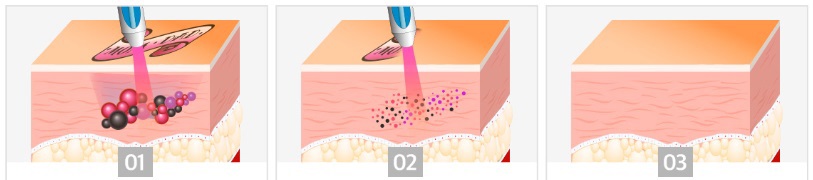
The Science Behind Laser Tattoo Removal
Effective laser tattoo removal is not simply a matter of applying strong laser energy — it requires detailed analysis of tattoo pigments, individual skin condition, and the interaction between laser wavelength and pigment composition before any treatment is performed. The Reverse system is designed to accurately target pigment particles at their specific depth and color characteristics while minimizing unnecessary damage to surrounding skin tissue.
3-Step Removal Mechanism:
Step 1 — Pigment Analysis Tattoo color, depth, and density are carefully evaluated before any laser settings are determined. Different ink colors absorb different laser wavelengths — meaning a thorough analysis of pigment composition is essential before calibrating the treatment for effective and safe results.
Step 2 — Laser Fragmentation Laser energy is precisely delivered to the tattoo pigment particles — breaking them into smaller fragments within the skin. The laser pulse duration, energy level, and wavelength are all calibrated specifically for the individual tattoo's color and depth characteristics at this stage — minimizing impact on surrounding tissue while maximizing pigment fragmentation effectiveness.
Step 3 — Natural Elimination The fragmented pigment particles are gradually eliminated by the body's natural metabolic and immune processes over time. This elimination occurs progressively between sessions — which is why multiple treatments spaced at appropriate intervals produce the most effective cumulative clearance.
4-Step Procedure Process:
Step 1 — Personalized Consultation and Pigment Analysis Detailed 1:1 consultation assessing tattoo location, pigment type, color composition, ink depth, skin type, and individual condition — before any treatment plan is established. Keloid history and skin sensitivity are also assessed at this stage.
Step 2 — Anesthesia Method Selection The appropriate anesthesia approach is selected per tattoo size, session duration, and patient sensitivity — options include topical anesthesia, local anesthesia, or sedation anesthesia managed by Deesse's dedicated anesthesiology specialist.
Step 3 — Laser Treatment Session Laser energy is precisely applied according to the individually calibrated protocol — targeting pigments at their specific depth and color characteristics for safer and more effective removal per session. Treatment protocols are adjusted as clearance progresses across sessions.
Step 4 — Post-Treatment Care Guidance Detailed aftercare instructions are provided following every session. The next session is scheduled based on treatment progress, skin recovery status, and pigment response.
Treatment Areas: Laser tattoo removal can be performed on all body areas — shoulders, back, arms, wrists, waist, pelvic area, legs, ankles, hips, and other body regions. Treatment methods are adjusted per skin thickness, tattoo color, and pigment depth in each specific area.
Expected Improvements May Include:
- Progressive reduction in tattoo visibility across treatment sessions
- Effective pigment targeting across single and multi-color tattoos
- Minimized surrounding skin damage through precise wavelength calibration
- Comfortable treatment experience through sedation anesthesia option
- More efficient clearance through optimized individually calibrated protocols
- Gradual return toward clearer, healthier-looking skin
Results vary significantly by individual. Complete removal is not guaranteed for all tattoos — particularly those with certain ink colors, deep pigment placement, or high density. The number of sessions required varies based on tattoo characteristics, skin type, and individual response. No specific outcome is guaranteed.
Post-Treatment Care at Deesse
Detailed aftercare instructions are provided after every session — supporting skin healing and minimizing side effect risk between treatments.
Key care points include avoiding alcohol, smoking, saunas, and intense exercise for at least three days following each session. Applying a cold compress on the treatment day helps reduce swelling and discomfort. Temporary redness, swelling, or crusting may occur after treatment and typically improves gradually over time. Hair in treated areas may temporarily shed but usually regrows naturally.
Patients prone to keloid scarring should inform the clinic before treatment begins — allowing individualized protocol adjustment. Avoid forcefully removing scabs between sessions — this reduces the risk of post-treatment pigmentation changes or scarring. Sessions are typically spaced four to six weeks apart to allow appropriate skin recovery and natural pigment elimination between treatments.
Results, Safety, and What to Expect
- Results and Session Requirements: Most tattoos require multiple treatment sessions for meaningful clearance — the exact number depending on ink color composition, pigment depth and density, tattoo size, skin type, and individual metabolic response. Sessions are spaced four to six weeks apart to allow skin recovery and progressive natural pigment elimination between treatments. Individual response varies significantly and no specific clearance result is guaranteed.
- Safety Profile: Laser tattoo removal at Deesse uses pigment-specific wavelength calibration to minimize unnecessary tissue damage. Sedation anesthesia is available and managed by a dedicated certified anesthesiology specialist. Keloid-prone patients receive individualized protocol adjustment. Post-treatment care instructions are provided and follow-up sessions are monitored for treatment response and skin healing.
- Possible Side Effects: Temporary redness, swelling, crusting, and skin sensitivity are expected following treatment. Pigmentation changes, incomplete clearance, and textural change are possible — particularly with certain ink colors or deep pigment placement. All individual-specific considerations including keloid risk are discussed openly during consultation.
Why Choose Deesse for Laser Tattoo Removal?

Laser tattoo removal at Deesse is distinguished by two elements that directly determine the quality and comfort of the experience — expert pigment analysis before every session ensuring laser calibration is matched to the actual characteristics of each tattoo, and sedation anesthesia availability that makes comfortable treatment accessible regardless of tattoo size or location. Together, these elements remove the two most common barriers to effective tattoo removal: inadequate treatment precision and fear of discomfort.
Deesse's five core pillars support every laser tattoo removal case:
- Patient-Centered Specialists — Every treatment plan is built around your specific tattoo characteristics, skin condition, and comfort preferences.
- Emergency-Ready System — Full clinical safety infrastructure including dedicated anesthesia specialist for every sedation procedure.
- Customized Anesthesia by Specialist — Individualized anesthesia protocol — topical, local, or sedation — designed for every patient's specific needs.
- Total Care Recovery Program — Detailed aftercare guidance and scheduled follow-up monitoring through every session.
- Collaborative Field-Specific Team — Experienced laser specialists and anesthesia specialist coordinated for every removal case.
Real Patient Experiences
Large Back Tattoo Removal with Sedation, Patient in his 30s
This patient had been putting off treatment for a large back tattoo for years due to pain concerns. Following consultation and sedation-assisted removal sessions at Deesse, he described the experience as entirely different from what he had feared — comfortable throughout, and with visible clearance progressing meaningfully across sessions.
Multi-Color Arm Tattoo Removal, Patient in her 20s
This patient had a multi-color arm tattoo with several difficult-to-treat pigments. The Deesse team's detailed pigment analysis identified the specific wavelength requirements for each color. She described the approach as noticeably more targeted and effective than a prior experience elsewhere — and visible clearance progressed more efficiently than she had expected.
Clearer Skin Is Possible — Precisely and Comfortably
Whether you want to fully remove an unwanted tattoo, partially fade it, or finally proceed with treatment you have been putting off because of pain concerns — laser tattoo removal at Deesse Plastic Surgery offers a precisely calibrated, individually planned path toward clearer, healthier-looking skin. With sedation anesthesia available and experienced specialists behind every session, the treatment at Deesse is designed to be as effective and as comfortable as possible.
[Book Your Free Tattoo Removal Consultation Today]
Your consultation is free, confidential, and comes with no obligation. Our patient care team is ready to answer your questions and schedule your appointment.
Other Services
Explore additional treatments offered by our specialists.

Male Double Eyelid
Male eye surgery at Deesse Plastic Surgery is a specialized aesthetic procedure designed to improve the appearance of the eyes while preserving and enhancing masculine facial characteristics.
Learn More

Square Jaw Reduction
Achieve a refined V-line with expert square jaw reduction at Deesse Plastic Surgery. Board-certified surgeon Dr. Jin Hyung Kim. 3D precision. Minimal stepped effect. Book today.
Learn More

Breast Reconstruction
Breast reconstruction surgery is a reconstructive procedure performed to restore the shape, volume, and contour of the breast following mastectomy due to breast cancer treatment, trauma-related deformity, congenital breast absence, or post-surgical asymmetry.
Learn More